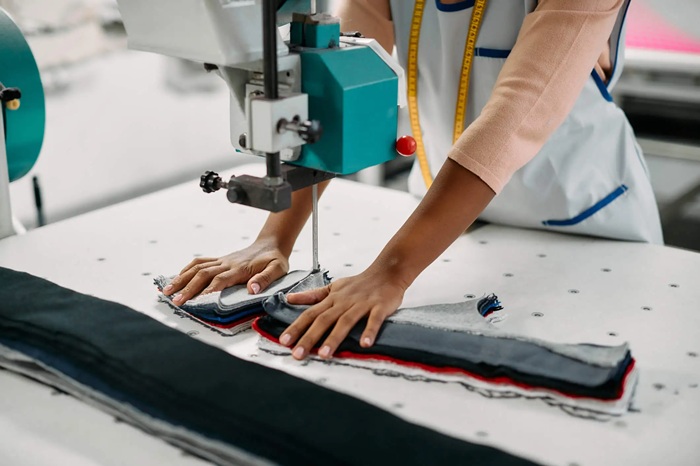

An enterprise from India is creating an ecosystem of thousands of self-employed women, who work where they are than in far-off traditional garment factories. Industree Foundation was founded in 2000. Some 30 million women in India rely on fashion for employment. Industree aims to tackle poverty in the garment manufacturing industry and enable the garment industry to grow sustainably, embracing new technologies and empowering women.
Industree goes to tribal artisans and works with them in mud huts. It helps organise them into production units and create a sustainable business at the lowest possible cost.
In a traditional Indian garment factory, women commute on an average four hours a day. They either have to pay rent if they live away from home, or pay high daily travel costs, and are then vulnerable to having their wages, which are sent home to support the family, taken by a man.
Industree’s goal is to decentralise manufacturing, with the micro-entrepreneurs required to commute no more than five kms. This means women can keep more of the money they earn, and put more into child nutrition, the household, and the local community. This is also linked to a fall in domestic violence. Educating women on ethical production practices could also have an impact on climate change.

- 1
- 2
- 3
- 4
- 5
- 6
- 7
- 8
- 9
- 10
India’s 45°C economy is reshaping apparel retail and consumer spending
The intensifying heatwaves sweeping across the Indian subcontinent are no longer mere meteorological anomalies; they have become the primary engineers... Read more
FY26 Textile Scorecard: Integration, specialization are winning the margin battl…
As the curtains close on FY2025-26, India’s textile industry is revealing a sharp divide. On one side stand integrated and... Read more
Intertextile Shenzhen 2026: Pioneering the Future of Textile Innovation
As Shenzhen cements its status as China’s premier hub for manufacturing, artificial intelligence, and startup cultivation, Intertextile Shenzhen Apparel Fabrics... Read more
The Devil Wears Prada 2 reflects fashion’s power shift, where consumers replace …
" " The release of The Devil Wears Prada 2 has sparked a debate far bigger than a Hollywood sequel. What... Read more
The 30-minute problem reshaping the $63 bn leggings market
The global leggings makers are racing to solve one of the apparel industry’s most expensive hidden problems: discomfort that appears... Read more
Why the resale explosion is failing to slow apparel production
The global apparel industry is confronting an uncomfortable paradox. The explosive rise of the resale economy, once viewed as a... Read more
Can India’s textile sector convert FTAs into global dominance?
What began as a cautious China Plus One sourcing strategy for global apparel trade, has now evolved into a full-scale... Read more
No More Easy Wins: Why global retailers are losing ground in China
China’s retail sector has entered a new phase, one defined not by aspiration, but by scrutiny. The long-standing advantage enjoyed... Read more
Resale overtakes fast fashion as vinted climbs UK Retail rankings
For the first time in decades, the British fashion market is witnessing a major change as resale platform Vinted secures... Read more
Shein Buys Everlane: Why sustainable fashion brands are losing the scale war
The acquisition of Shein by premium basics label Everlane marks a defining moment in the global apparel industry. What initially... Read more