
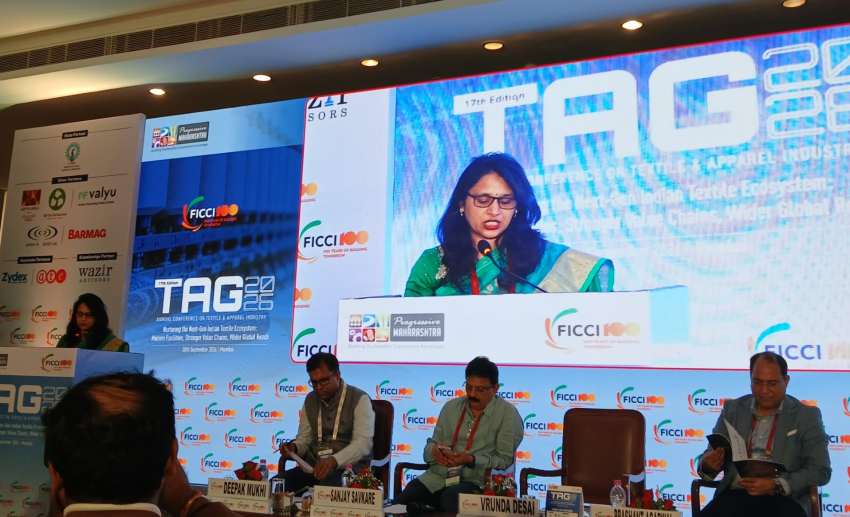
In a stern regulatory announcement aimed at creating a robust statistical backbone for India's textile sector, Textile Commissioner Vrunda Manohar Desai has stated that all GST-registered textile units and cotton traders must compulsorily register and submit their returns on the revamped Textile Statistical Return System (TSRS) portal, warning that penalty proceedings for default begin from October 1. Addressing industry leaders at the 17th annual FICCI-TAG 2026 conference in Mumbai, Desai also introduced a forthcoming Unique Textile Identification Number, confirming it will be strictly mandatory to access any central government scheme, subsidy, or financial incentive. Under the Collection of Statistics Act, filing monthly returns and annual surveys is an enforceable obligation, and without the new unique identity, industrial units will be completely cut off from Government of India benefits.
Trade Agreements: Seizing the "Narrow Window"
Highlighting global market dynamics, the Textile Commissioner urged exporters to act swiftly on new bilateral pacts, cautioning that the competitive advantage offered by the in-force India-UK trade pact is confined to a narrow window that will shut once rival exporting nations seal similar deals. With the India-EU Free Trade Agreement already signed and nearing final ratification, Desai stressed that domestic manufacturers must immediately undertake the groundwork, structural upgrades, and compliance measures necessary to capture immediate European market share.
Modern facilities & infrastructure overhaul
To overcome cluster fragmentation and reduce high logistics turnaround times, Desai outlined key integrated manufacturing interventions anchored by seven PM MITRA mega-parks and 100 plug-and-play industrial hubs under the BHAVYA scheme. Citing findings from an official third-party evaluation of the ATUFS scheme—which unlocked ₹53,121 crore in investments from ₹2,776 crore in subsidies (a 1:19 leverage ratio), installed 67 lakh modern machines, and created 36 lakh jobs—she revealed that future MSME-driven modernisation across weaving, processing, and garmenting will be propelled by the Union Budget's Textile Expansion and Employment Scheme (TEES). Simultaneously, erstwhile Powerloom Service Centres have been restructured into Integrated Textile and Apparel Development Centres (ITDACs) to provide technical testing, credit linkages, raw material monitoring, and handholding for AI adoption across 200 MSMEs in tandem with the India AI Scheme and Samarth 2.0 workforce skilling.
Resilient value chains & sustainable fibres
Targeting India's long-term goal of building a $350-billion textile economy with $100 billion in exports by 2030, government strategy is focusing heavily on farm-level raw material security and fiber diversification. Upstream cotton productivity is being backed by the ₹5,659-crore Kapas Kranti mission alongside global traceability certification under Kasturi Cotton Bharat, while downstream synthetic capacity is scaling via the PLI scheme, which has secured committed investments of ₹12,823 crore from 96 companies in its third round. Concurrently, ITDAC facilities are championing circular and alternative fibers such as bamboo, hemp, pineapple, flax, and milkweed, with R&D translation fast-tracked through the TexRAM initiative.
Global market access & ESG alignment
Desai highlighted that decentralized district and state export action plans spanning 548 exporting districts are being synthesized into a comprehensive National Textile Export Roadmap for 2030. Exporters will receive coordinated institutional backing through a ₹25,000+ crore export promotion scheme offering affordable trade credit under Niryat Protsahan and compliance enablement under Niryat Disha, supported on the ground by six newly commissioned Textile Export Facilitation Centres (TEFCs). Addressing tightening global ESG norms, the Commissioner noted that the Union Budget’s TECS-Eco scheme, along with multilateral interventions involving UNIDO and the Global Environment Facility (GEF), will assist units in eliminating hazardous effluents, lowering carbon emissions, and building trust in sustainable Indian manufacturing.
Industry deliberations at FICCI-TAG 2026
The daylong conference, themed “Nurturing the Next-Gen Indian Textile Ecosystem: Modern Facilities, Stronger Value Chains, Wider Global Reach”, was jointly inaugurated with Maharashtra Textile Minister Sanjay Savkare, who released the FICCI-Wazir Annual Textile Industry Report 2026 and called for scale, automation, and industrial consolidation across state clusters. Emphasizing the export stakes, Additional DGFT R.K. Mishra pointed out that if Indian manufacturers align production with global demand and double overall exports in the next five years, annual shipments to the European Union alone could expand by USD 7–10 billion, provided the industry rapidly scales technology, optimizes supply chains, and utilizes available trade risk covers.