

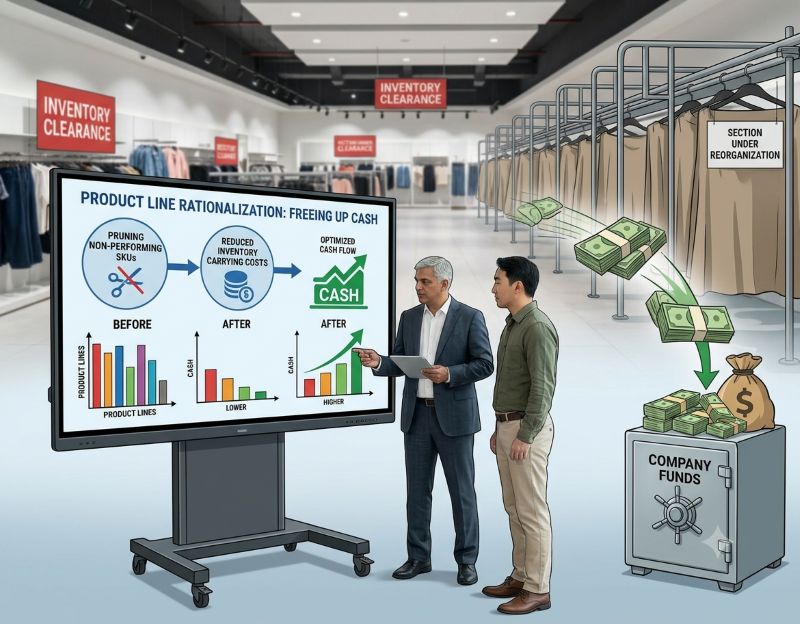
Apparel brands are cutting product complexity to protect margins, reduce inventory risk and improve cash generation. After years of expanding assortments to capture every consumer segment, retailers are discovering that excessive choice can weaken profitability without delivering proportionate sales growth.
Industry benchmarking suggests that the bottom 30-40 per cent of stock-keeping units (SKUs) across apparel and footwear generate less than 5 per cent of gross commercial revenue while absorbing more than 25 per cent of working capital and design resources. These marginal products add costs across sampling, sourcing, manufacturing, warehousing and markdowns, often without generating meaningful demand.
The shift towards smaller, more focused collections reflects mounting pressure from subdued discretionary spending, higher logistics costs and persistent promotional activity. Instead of multiplying styles, colours and seasonal variations, brands are concentrating resources on proven sellers and distinctive products that command stronger full-price realisation.
Brands cut back
The reset spans mass-market sportswear, denim and luxury fashion. Under Armour has reached an initial target of reducing its SKU count by 25 per cent and is pursuing a further 25 per cent reduction across its collections. The strategy prioritises product productivity and full-price sales over indiscriminate assortment expansion.
Levi Strauss for example, is concentrating on established denim franchises, including the 501, while reducing slow-moving style and colour variations. Lululemon has cut assortments in North American stores by 15 per cent, seeking to simplify store operations, improve replenishment and eliminate redundant inventory.
Luxury brands are following the same logic. Gucci has reduced its product range by approximately 20 per cent, refocusing on core leather goods and premium wardrobe staples. Burberry, under chief executive Joshua Schulman, is narrowing seasonal assortments around outerwear, scarves and its signature trench coats.
Hugo Boss has also made product simplification a central part of its Claim 5 strategy, targeting a 20 per cent reduction in collection complexity by 2028. The objective is to improve inventory productivity, strengthen profitability and generate more free cash flow.
Table: Catalog rationalisation benchmarks
|
Brand |
Assortment strategy |
Primary objective |
|
Under Armour |
Targeting cumulative 50% SKU reduction |
Improve full-price sales and margins |
|
Hugo Boss |
20% reduction in collection complexity by 2028 |
Increase free cash flow and operating earnings |
|
Lululemon |
15% SKU reduction in North American stores |
Improve store efficiency and replenishment |
|
Gucci |
Approximately 20% range contraction |
Strengthen brand identity and core categories |
|
Burberry |
Narrower seasonal assortments |
Concentrate sales on outerwear and heritage products |
The cost of complexity
Every additional SKU creates costs beyond its manufacturing price. Product development requires technical specifications, pattern-making, fit approvals, sampling, fabric commitments and merchandising support. Once products enter the supply chain, each variation adds forecasting requirements, warehouse locations, inventory tracking and replenishment decisions.
Industry estimates put the incremental development and administrative carrying costs of introducing a SKU at $3,000 to $10,000 before it reaches the retail floor. While the precise cost varies by product and business model, the underlying economics are clear: low-volume styles can consume disproportionate resources.
Fragmented assortments also weaken purchasing power. When orders are spread across numerous designs, colours and fabric specifications, sourcing teams struggle to secure volume discounts from mills and factories. Smaller production runs can increase unit costs, complicate quality control and extend lead times.
The problem continues at the point of sale. Too many similar products can blur brand positioning and make purchasing decisions harder. When demand fails to meet forecasts, retailers resort to markdowns to clear stock, eroding margins and tying up capital that could have supported replenishment of stronger sellers.
Reducing assortment breadth allows brands to concentrate buying volumes behind validated products. Larger production runs can improve sourcing terms, while simpler inventory structures support faster replenishment and better stock visibility.
Hugo Boss’s margin play
Hugo Boss shows how assortment discipline can support a broader financial reset. Through its Claim 5 programme, the German fashion group is working towards reducing collection complexity by 20 per cent by 2028, alongside its wider profit and cash-generation targets.
The company’s approach focuses on strengthening core product categories, improving sourcing efficiency and reducing dependence on promotional sales. Gross margin grew by 200 basis points to 64.9 per cent, while group inventories declined 15 per cent year on year. The business also generated over €100 million in quarterly free cash flow.
These results underline the potential benefits of tighter assortment management, although margin performance also depends on pricing, product mix, demand and promotional intensity. SKU reduction alone does not guarantee a turnaround.
For Hugo Boss, the objective is to direct capital towards products with stronger commercial potential rather than maintaining an expansive range for its own sake. A more disciplined collection can improve inventory turnover and cash conversion while reinforcing the brand’s core positioning.
Precision over breadth
The industry’s assortment reset marks a shift away from the assumption that more products automatically produce more sales. Retailers are evaluating collections by their contribution to revenue, gross margin, inventory turns and working-capital efficiency.
The challenge is to remove unproductive complexity without sacrificing innovation or consumer relevance. Excessive pruning can leave gaps in sizes, price points and customer needs, while overdependence on a narrow group of bestsellers can increase concentration risk.
Brands must therefore distinguish between commercially redundant options and products that serve a clear strategic purpose. Better demand forecasting, SKU-level profitability analysis and faster replenishment can help merchandising teams make that distinction.
For apparel businesses operating under tighter margins, assortment discipline is becoming a competitive tool. The priority is no longer to offer the largest possible range, but to build collections that sell through efficiently, support brand identity and generate stronger returns on invested capital.