

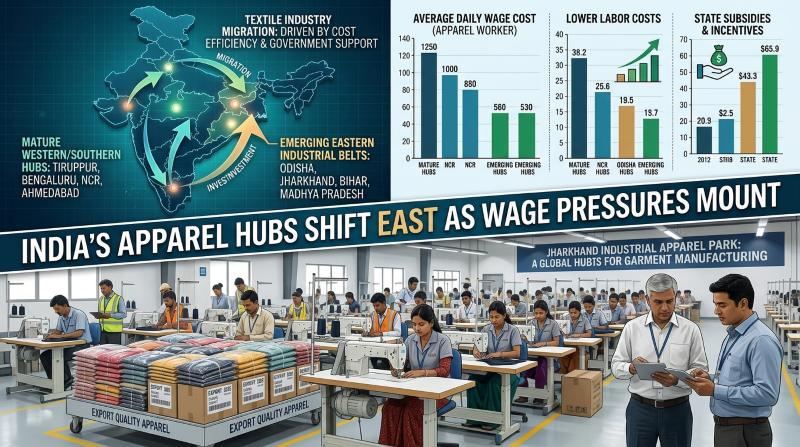
India’s apparel manufacturing sector is beginning to shift production beyond traditional hubs such as Tirupur, Bengaluru and the National Capital Region (NCR). Increasing wages, labour shortages, worker attrition and expensive industrial real estate are pushing manufacturers to explore Odisha, Bihar, Jharkhand and Madhya Pradesh. The shift reflects a change in factory revenuues. Cutting, sewing, finishing and packing account for an estimated 25-35 per cent of garment operating expenses making labour costs critical to competitiveness. Monthly wages for skilled workers in established clusters often range from Rs 11,000-15,000, while emerging production centres offer lower statutory wage structures, typically around Rs 8,000-10,000.
For exporters operating on net margins of just 5-8 per cent, the difference can influence investment decisions and order profitability. Manufacturers are also seeking to reduce dependence on migrant labour by locating factories closer to workers’ home states.
The cost equation
|
Production hub |
Typical monthly wage (Rs) |
Worker availability & migration |
Ancillary & supply chain |
|
Bengaluru (Karnataka) |
12,500- 15,000 |
Severe competition from electronics, gig sectors; high urban attrition |
Mature fabric sourcing, wash plants, export clearance infrastructure |
|
Tirupur (Tamil Nadu) |
11,000- 13,500 |
High reliance on circular migrant labour; acute seasonal shortages |
World-class knitwear ecosystem within a 15-km radius |
|
Odisha / Jharkhand |
8,000- 9,500 |
Large resident workforce; minimal local alternative manufacturing |
Developing; raw fabric and trims shipped from west and south |
|
Madhya Pradesh / Bihar |
8,200- 10,000 |
Native migrant catchment; low absenteeism during farm cycles |
Developing; dependent on long-haul transit to container ports |
Note: Wage ranges are indicative not verified state-wide averages.
Incentives drive investment
For decades, garment factories in southern India relied on workers migrating from Bihar, Odisha and UP. Establishing production closer to these labour pools can reduce recruitment expenses, accommodation costs and disruption caused by seasonal migration.
State incentives are strengthening the case for relocation. Textile and apparel policies in emerging manufacturing regions offer varying combinations of capital subsidies, power concessions and employment-linked support. The source material cites capital subsidies of up to 30 per cent, electricity concessions of Rs 2 per unit and monthly employment grants of Rs 3,000-5,000 per worker for periods of up to five years, subject to scheme-specific eligibility.
These incentives can reduce the initial cost of setting up greenfield factories. However, their value depends on disbursement timelines, infrastructure availability, workforce training and the ability to sustain production at commercially viable efficiency levels.
The logistics gap
Lower wages do not automatically translate into lower manufacturing costs. Established clusters such as Tirupur have tightly integrated networks of spinning mills, dyeing and processing units, printing facilities, trim suppliers and garment manufacturers. Their proximity reduces inventory requirements, coordination costs and turnaround times.
Emerging eastern and central hubs lack comparable supplier density. Manufacturers may need to transport fabric from southern or western mills to inland factories and then move finished garments to ports such as Chennai or Nhava Sheva. Additional freight movements can extend lead times by three to five business days, complicating orders that require fulfilment within 45 days. Longer transit routes also increase exposure to logistics disruptions and working-capital requirements.
Productivity has another challenge. Newer factories may initially achieve line efficiencies of 45-55 per cent, compared to 75-85 per cent in established centres. Closing that gap requires investment in training, experienced supervisors, production planning and quality control. Wage savings must therefore be measured against the cost of building operational capabilities.
A hub-and-spoke model
Apparel manufacturers are now exploring a division of production between established clusters and emerging locations. The source material identifies KPR Mill’s reported Rs 450-crore investment in Odisha, alongside production expansion by Gokaldas Exports and Pearl Global Industries in central India and adjoining regions. Page Industries is also cited as expanding its manufacturing footprint in eastern India.
Under a hub-and-spoke model, factories in newer locations can handle standardised, high-volume products such as basic T-shirts, briefs and loungewear. Established facilities can retain complex garments that require specialised processes, established supplier relationships and higher technical capabilities.
This approach allows manufacturers to diversify labour supply and production capacity without immediately replicating the entire textile ecosystem in a new location. The logic is clear: factory location is increasingly determined by the balance between labour availability, productivity, logistics and proximity to suppliers not simply access to ports or established industrial infrastructure.
Page Industries, the exclusive licensee of Jockey International across India and several neighbouring and Gulf markets, also holds licensing rights for Speedo. Founded in 1994, the company manufactures innerwear, loungewear and athleisure through a network of 16 manufacturing units.
The source material reports FY25 revenue of ₹49,349 million and operating margins above 21%, alongside an expansion strategy that includes eastern India. Its distribution network spans more than 110,000 retail touchpoints.
For manufacturers with substantial domestic distribution networks, additional production locations can support volume growth and diversify operational risk. But inland expansion will deliver lasting savings only if factories build productivity, secure reliable suppliers and control freight costs.
India’s garment industry is not abandoning its traditional hubs. It is recalibrating their role. As labour economics change, established clusters may increasingly concentrate on technically demanding production while emerging centres compete for standardised, labour-intensive orders. The success of this transition will depend on whether lower wages can offset the costs of distance, training and ecosystem development.